Tuesday, 14 July 2026

Why Relying on Bank's Fire Insurance for Mortgaged Home Is Technically a Financial Death Sentence? (Part 2)

 
Hi Folks, welcome back to Investment Income For Life and my Part 2 yapping on the above subject. Coming off from my Part 1 post on Home Insurance, I hope I do not give an impression that everyone needs to purchase an insurance to cover for building structure in event of a fire or other peril. The thing is that both private Condo and HDB actually already stipulated mandatory coverage which I should just briefly mention in Section 1 below for those interested in the detailed technicalities so that we do not buy the wrong insurance coverage- the focus should be on Home Renovation and Content which will be discussed in Section 2 below as well as common peril in Section 3 such as leaking water from your unit into the neighbours below and causing of 3rd party liability due to water damages or injuries from the resultant slippery floors.

1. Fire Insurance For Building Structure Generally Already Covered
(i)  For private condominiums
The Management Corporation Strata Title body ("MCST") will actually need to purchase fire insurance to cover fire damages to the entire building structure and common areas. By building, it also includes the initial fittings such as windows, doors, floorings, water pipes, aircon, gas pipes, electrical wiring and false ceiling concealment work etc that were furnished by the original developer during TOP. Nevertheless, these does not cover any subsequent enhancement or upgrades which can be quite substantial. 

Basis of law: The law for this is stipulated under Section 70(1) of the Building Maintenance and Strata Management Act (BMSMA) of Singapore, the Management Corporation Strata Title (MCST) is legally mandated to purchase and maintain a master damage insurance policy for the estate against fire, lightning, explosion, and other prescribed risks.

(ii) For public HDB
If you bought your HDB flat using an HDB housing loan, you (the flat owner) are legally required to buy and renew the HDB Fire Insurance policy every 5 years for the entire duration of your loan. If your loan is paid off: Once your mortgage is S$0, the mandatory requirement drops, and keeping the fire insurance becomes completely optional (though highly recommended as basic prudence).

Basis of law: The Prescribed Legislation: Interpretation (Housing and Development Board — Fees) Order 2026 (Under Section 46(1) of the Interpretation Act 1965). Section 46(1) of the Interpretation Act is the legal "bridge." It gives the Ministry of National Development the concrete legislative authority to draw up binding rules (like the Fees Order 2026) that legally solidify HDB's administrative right to force flat purchasers into the mandatory HDB Fire Insurance Scheme.

2. What is the Home Insurance Coverage That is Normally Missing and Actually Needs to Be Covered?
The costly parts that are not covered in event of fire will be your renovation and home content. Simply put, these will be your enhancement or home purchases after getting the keys to your unit. For example, some folks will change the entire flooring or hack away walls, building magnificent TV Consoles with luxurious wall features and build new wardrobes and cabinets. These renovation alone can cost S$10K to S$200K depending on the enhancement. This is not cheap. Hence one needs to buy personal home insurance to cover this essential component to ensure you have a decent size funds to redo your personal space.

3. Water Leakages From Your Unit Spreading To Neighbours Unit and Getting Lawyer's Letter and Lawsuits.
This is actually a common problem that one will sooner or later encounter. The scary part is that if your unit causes your below neighbour's ceiling to leak, you will be held 100% responsible for repair costs if you are living in a private property and 50% split of repair responsibility between upper and lower floor if you are living in a HDB (there is now a special scheme where HDB will chip in 50% for repair and remainder split between the neighbours).

The bomb here is actually not the repair bill but the consequential damages from the leak that causes say S$100K due to extensive damages. The Singapore Court will not follow the 50%-50% split. They will look into who is the negligent party and there is a probability and financial exposure here that you maybe held responsible for over 6 figures sum of damages being filed against you.

This is where home insurance 3rd Party Liability protection comes into place. You would want to prevent a huge dent to your wallet in such an unfortunate event.

For the fun of it, this coverage and protection is strangely known as the "Family Worldwide Personal Liability". The mind boggling use of the term "Worldwide" here is that it actually covers more than home risk. Say if you travel overseas and were eating an ice-cream and you accidentally dropped the ice-cream and an elderly man stepped on the dropped ice-cream and sue you for injuries from slipping on your ice-cream, you can activate this coverage here to cover for 3rd party liabilities. The only reason it is often bundled into home insurance policy is that leaking of water to the unit below is one of the very common problems that are likely to occur.  

4. Other Common Issues to Note Regarding Home Insurance Coverage
Tracing and hacking to trouble-shoot water leakage in home is often costly and can cause a few thousand dollars of financial damage. Take note that not every home insurance policies cover this aspect- they only cover for consequential water damages to tiles and walls but DO NOT cover for the hiring of plumber and contractors to do hacking through tiles for tracing of water seepages behind walls or ceilings.  For example, SOMPOS which used to have it under their Home Bliss series policy under "Enhanced Peril" has actually quietly removed them. I can also no longer find this coverage under their latest HomeMax or HomeVital polices.

The only insurance companies that I know of that still insured the seepage trouble-shooting and repair are MSIG and Income Insurance Ltd but even then, they are only willing to cover this on a co-payment basis. For example, Income Insurance will only cover such water seepage tracing and repair work for up to maximum S$5,000 and only subject to 80% of any cost with the remaining 20% chipped in by yourself.

Parting Thoughts
It is crucial that one actually buys his or her own home insurance protection in order to cover the gaps in protection from areas as above-mentioned, other than the usual building structure reinstatement. Ok, that's all from me today on the topic of home insurance coverage- have a great week ahead!

Why Relying on Bank's Fire Insurance for Mortgaged Home Is Technically a Financial Death Sentence? (Part 1)

 
Hi Folks, good day to all. I am in the midst of renewing my home insurance when I discovered that many of my colleagues and friends do not even buy any home insurance. The common reason given was that while taking out the mortgage from the bank, the banker have already stipulated that the home owner will need to pay for the mandatory fire insurance. This thus give rise to a belief that there is already a home insurance coverage for major fire and the resultant damages.   

1. The Misconception-The Bankers Purchased For You liao
Unfortunately, this is the greatest myth and misconception along 2 lines. 

Firstly, the mandatory fire insurance purchased will only cover for the structure of the building as well as any other original fittings and fixtures given by the developer. It does NOT cover the internal renovation as well as purchase of new TVs, ceiling fans, sofa, dining table set, refrigerator, bed-frames & mattresses etc. 

Secondly and this is the most important and slightly complicated part. This fire insurance purchased by the Banker is actually structured for the insurer to pay off the loan owed by you in the event of a disastrous fire. Let me elaborate further below and imagine you have a outstanding mortgage loan of S$500K.

2. The mandatory fire policy that a bank forces a buyer to take out has very explicit legal terms. It acts as a hybrid: it is legally structured as a "property reinstatement policy", but it operates practically as a "loan-repayment mechanism" for the bank.
Here are the exact terms and mechanisms of how a standard bank-mandated Mortgagee Interest Policy (MIP) works:

(i) The Core Insurance Terms
The banker usually sets the maximum coverage limit to match either the outstanding loan amount or the building's reinstatement value (whichever is lower). It completely ignores the market value of the property or the value of your possessions.

(ii) The Loss Payee Clause (Mortgagee Clause)
The most critical term in the policy states that the Banker is the sole "Beneficiary (Loss Payee)". Legally, the contract dictates that in the event of a major loss, the insurance company cannot pay you directly. They must pay the bank.

3. Does it fix the fire damage or just pay off the bank?
It actually "does both", but the priority is entirely skewed toward clearing the bank's debt. Here is the exact chain reaction after a devastating fire:

Step A: The Insurer Pays the Bank (Paying off the loan)
Because the building (the bank's collateral) is destroyed, the insurance company assesses the damage. If the property is completely uninhabitable or ruined, the insurer pays a lump sum directly to the bank to completely or partially wipe out your outstanding mortgage balance. The bank is made whole and walks away happy. Your debt to the bank disappears.

Step B: The Reinstatement Right (Fixing the fire damage)
Technically, because it is a property policy, the insurance funds can be used for reinstatement. However, because the bank is the primary "owner" of the policy benefits, the choice is entirely up to them.

4. The Ultimate Catch: The Law Behind It
Under Singapore's Building Maintenance and Strata Management Act (BMSMA) and general insurance laws, if the insurer pays off your loan to the bank, a legal transition happens, that is, the insurer takes over as the mortgagee.

This means the insurance company effectively "buys" your debt from the bank via re-assignment. The bank leaves the picture, and you must now continue to make your monthly mortgage payments directly to the insurance company instead. 

Summary
In other words, the fire insurance purchased in favour of the bank as beneficiary is not a real fire policy-it serves merely to transmit the risk of default in monthly repayment by the mortgagor and assign them to the insurer.  In the event of major fire damages, you will not have control over the funds from this particular fire policy for reinstatement of the building structure, original developer given fixtures and also fittings. In addition, as mentioned earlier, there is another major financial exposure that can range from S$20k to S$100K for the renovation and house contents that were destroyed and also temporary housing costs. Since this post is getting too lengthy, I will stop here and break further discussion, in another blog post (Part 2), on where the actual funds for reconstruction is coming from and whether one need to buy your own fire insurance.

Tuesday, 12 May 2026

SG Government Finally Revised Executive Condo Purchase Rules- Just Do Away with EC Scheme.


I read in absolute amazement at the devastating new property measures released by the Singapore Government with regard to changes in conditions for buying an Executive Condo (“EC”) in Singapore. These changes will apply to government land sales from May 8, 2026 which means that it will occur somewhere in late 2027 or early 2028 given the requirement for developers to only be able sell EC 15 months after successful land bid. Many private developers and 2nd time HDB upgraders are probably cursing and swearing at the upcoming changes. 

1. Latest Changes Summarised
So for couple who decided to apply for EC and getting married soon at age 28, waiting for TOP takes around 2 years while the new Minimum Occupation Period (“MOP”) thereafter is 10 years will mean a long waiting time to flip EC of 12 years, that is age 40 already. This will definitely address the current unhealthy trend of Singaporean couples using this as a mean to get rich via property flipping. 

The increased allocation from 70% to 90% reservation for 1st time buyer will also reduce the get rich 2nd time lottery for HDB upgraders who already benefitted from the Singapore get rich via HDB lottery system in the 1st round and now asking for 2nd bite of the cherry. Additionally, this will ensure more 1st time buyers benefit from owning their first property.

2. My Personal Take- Good Measures To Control Unsustainable Rise in EC Prices
Overall, I think this is good as developers will now be very worried about selling off all units in time lest they get into trouble with the 5 years sales penalty if they are still unable to market the units off. Developers will thus be more prudent in their EC bid.

3. EC Scheme Should be Removed.
Don’t flame me but I am not exactly a fan of the current EC scheme. Our HDB government agency has lost track of its original purpose post independence to help all Singaporeans own affordable housing for a roof over their heads. Building EC takes away precious land now used to build tennis court, swimming pool & landscaping which could be used to build an extra stack of BTO. Why should all tax payers be paying for folks who want to live in luxury property at the expense of the lower income group who are more in need of subsidies?

Hence, there should just be (i) BTO and (ii) private property class in Singapore. HDB housing is for Singaporeans to live in and not for flipping upon MOP. Those who wants to speculate or invest can just go directly to the private property market. 

Parting Thoughts
Personally, I think that these new measures are long overdue and bring EC in line with the BTO Plus and Prime area programmes of 10 years MOP. For too long, many Singaporeans have been treating an EC as a mean to get free government handout in the form of subsided land rates and special CPF grant of up to S$30K. Overall, many EC flippers simply just sell away after the previous 5 years MOP rule and walk away with half a million dollars of profit or even more to upgrade to private condo or to buy a landed home without any effort. A home is primarily for living in and not for speculation. I hope that this measure will also help moderate EC prices to benefit future generation and also spur more people to be more entrepreneurial by starting their own businesses to boost the economy instead of just lying flat and waiting for money to drop down via flipping of their EC for sure-win lottery gains. 

Sunday, 29 December 2024

Singapore Buyers Got Misled Into Investing Into Malaysia Johor Properties Under Private Lease Scheme- Slim Hope of Winning Civil Suit.

It is shocking when I read the news that some fellow Singaporean buyers are in legal dispute with a Malaysian developer over the form of ownership of Johor condo purchases. Apparently, these fellow Singaporeans have bought into a property under a "Private Lease Scheme (PLS)" that is unique in Malaysia but not in Singapore property market. It is akin to being a tenant as all the rights associated with ownership are missing and the only rights is to be able to stay in the condominium apartment for 99 years. You need to seek permission from the Developer to sublease or re-sell the unit.  

1. What is PLS?
Under such a scheme, the Malaysian developer retains ownership of the property and you essentially have a long-term rental agreement and NOT TRUE ownership. One thus does not have full ownership rights such as voting on condo management or selling the property freely. 

2. Where is the Disputed Residential Properties?
According to the Edge, some residential properties in Medini, an area within Iskandar Puteri in Johor, were sold in 2013 and 2014 under a PLS and not as 99-year leasehold condominiums. 

3. Statutory Claims Limit in Civil Suit as well as Signing the Sales & Purchase Agreement with Eyes Wide Open

3(i) Considering now is 2024 and that this matter is only raised up now, there will also be an issue of statutory expiry of civil claims lawsuit which is 6 years in Malaysia. Can affected PLS Singaporean buyers even file the suit in the first place on being mislead into paying for a PLS instead of a normal purchase?

3(ii) Also, even if they raise a claim successfully, how do these buyers argue their way out of an agreement that they have signed with eyes wide open in the first place?

Parting Thoughts
I thought that investing into Malaysian assets can become extremely risky if one is not careful in the due diligence process. Nonetheless, even if one is very careful, we should not forget about the constantly changing policy by the Malaysian government (depending on who is in power). We have seen the aftermaths of the 1998 CLOB issue where many Singaporeans lost their hard earn money overnight due to political risk. We have also seen Forest City which was marketed to many folks in China and Singapore as a 2nd residential home under special visa stay programme but which Mahathir's government subsequently reversed hence turning it into a ghost city. 

Moreover, even if there are capital gains of 100% in say 10 years, the depreciating currency based on historical trend against SGD will mean that the investment gain will be be wiped back to zero. Therefore, buying into Malaysian property is definitely more for staying or living in rather than as a form of investment. 

To put it bluntly, I think that the affected Singaporeans on PLS have very little room to maneuver to get the ownership title restored and will just be incurring more unnecessary legal fees expenses. The only stakeholder that will surely benefit the most will be the Malaysian la

Sunday, 15 December 2024

Crazy Singapore Property Price- Price Collapse Will Lead to Bursting of People's Dream.

When one sees Woodlands Condo, Norwood Grand, lauching at close to S$2,000psf and still gets snapped up like hotcakes, this signal something very wrong with the property market. Emerald of Katong launched at S$2,621 psf average also gets snapped up by 99% within a single weekend signalling a red hot property market. Once the bubble bursts, many folks will be saddled with over S$1.5Mil+ of mortagages. I still believe market goes up and down in cycles.....it cannot shoot up perpertually. Look at what is happening to Hong Kong property market right now. 

Be cautious when many people are bullish. Buy only if one has sufficent cash buffers. Don't end up being a slave to the banks.

Wednesday, 19 October 2022

Zyanya Review- City Fringe Freehold Condo At Geylang Food Haven And Near MRT Station With Incredulous Price Of S$1,700psf.


While I was on my way to lunch in the Geylang area, I walked past the Zyanya showflat located in a shophouse and thus decided to drop in for a quick visit. Zyanya is a freehold 34 units boutique condominium located in the eastern city fringe location of District 14. This is definitely one of the nearest free-hold condominium to Aljunied MRT station. You just need around 5 to 6 minutes to walk from Geylang Lorong 25A to the MRT station. Given the S$2,000plus psf new launch at Lentor Modern and AMO Residence at the Outside Central Region (OCR), Freehold Zyanya at 1,700psf at city fringe (Rest of Central Region- "RCR") appears to be a great steal. In addition, 99 years leasehold developments Sims Urban Oasis and the latest Penrose condominiums in the vicinity area are already asking for S$1,700psf to S$2,000psf. 
Front view

Zoom in front view-level 2 is the mechanised carpark

Side view

Backview

Besides the attractive price on offer for Zyanya, I am going to list down a few other highlights of staying in this well-known city fringe area:

1. Food Haven
Geylang is highly regarded to be one of Singapore's hot spots for famous hawker stalls and street food. One can always savour the famous Geylang fried prawn noodles and Geylang Frog porridges near the comfort of one's home. 

2. Excellent location well connected to other parts of Singapore 
5-10 minutes drive to Kallang Wave Mall, Suntec City, Bugis Junction and City Hall via Nicoll Highway. One can also get onto major expressway PIE or KPE within 5 minutes 

3. Units layout good but unfortunately some stacks facing West and will have afternoon sun
I will put up some of the better 4 bedder and 3 bedder layout below. For 1 bedder and 2 bedder will not be discussing here as the smaller bedder units have already been mostly snapped up by investors that I reckon are looking to rent them out.
4 Bedder + Study-1302sqft
The above is one of the best layout in Zyanya with spacious living room and even space set aside for a study area that can sit two people. Unfortunately, all the bedrooms are facing west and will get the afternoon sun which means that when you return back home from work, your bedroom will feel like a sauna. Since young I have a very low tolerance level for heat- the best I can accept is bedrooms with east facing which only gets the morning sun but this is my own personal preference. I do know of friends who like the sun a lot. 

4 Bedder-1195sqft
The 1195sqft D1 Type layout is my personal favorite as it is the only one with all bedroom facing the east (only morning sun issue). Its relatively smaller quantum for a 1195sqft means approximately S$2Mil for a 4 bedder configuration at a city fringe location.

3 Bedder+Study-1044sqft
Overall layout for the above 3 bedder + study is not efficient and appers to be odd shape to me. The dinning area is also tiny for a 3 bedder. Good thing for this layout is that there is a small area reserved as study area. Balconies are tiny. My thoughts are to pay a bit more to get the 4 bedder instead.

3 Bedder-893sqft
The compact 3 bedder layout for Zyanya is a bit strange. I thought that the junior master bedroom concept with space wasted for an attached bathroom wasted- it could have been better use for a larger kitchen area or even a small study area. Also, all bedrooms are west facing and will encounter the afternoon sun issue.

4. Limited facilities as only 34 units boutique

This is a small development hence of course, the facilities available are lesser than large scale development. But it does have a decent small lap pool of around 13m in length. There are a total of 28 carpark lots which should be more than enough given that there are 1 bedder and 2 bedders units whereby the owner bought for investment purpose as well as being near Aljunied MRT station, there is really not a need to own a car. But I guess the mechanised carparking system maybe an issue here especially if it breaks down  frequently after a few years of wear and tear- it will depend on how well it is being maintained. 

One should also take note that with only 34 units, managing the Management Corporation Strata Title ("MCST") and balancing the mgt funds book will not be as economical in scale relative to bigger developments with 300-500 units. For folks who purchased for own stay, he or she may even have to roll up their sleeve to join the Management Committee of the MCST to take on the laborious job of dealing with contractors, ensure maintenance is well taken care of as well as ensuring statutory compliance.
Zyanya lap pool at 3rd level.
Parting thoughts
If one is looking to resell their units in the short-term to mid term, then one has to be careful whether one wants to buy into a boutique development with only 34 units as there will only be a few transactions available for benchmarking during future resales. But if one wants to stay in the area for a longer term and to get a freehold city fringe home at an attractive entry pricing, then Zyanya may just be the right one for you.

Wednesday, 27 July 2022

AMO Residence Over 98% Sold In A Day- Singapore Property Market Shining Bright In spite of Economic Downturn. Will You Pay S$6K To Service Your Mortgage in Outside Central Region?


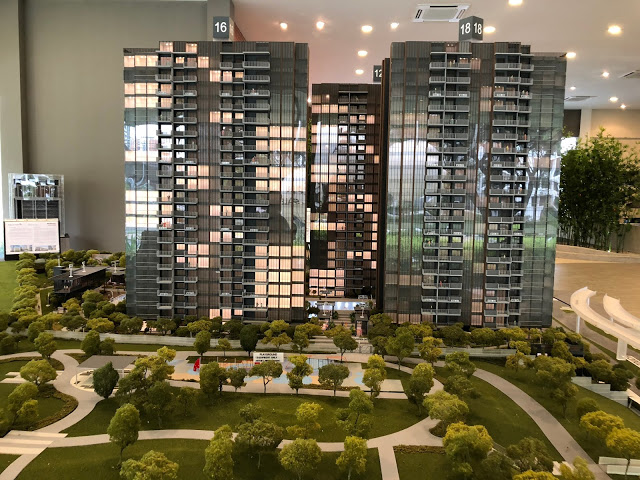
AMO Residence located off Ang Mo Kio Avenue 1 ended the weekend of 23 July 2022 with 98.1% of its 372 units all sold out. The average price of units sold is at incredulous S$2,100psf. What a crazy price for Ang Mo Kio. UOL Group and its partners are now laughing all the way to the bank. I can still remember back in 2010 when Centro Residences debuted at Ang Mo Kio Centre- it was going for  an eye popping S$1,200 psf by Far East Organization during launch and many people were saying that is so exorbitant and a record price of over the psychological  barrier of up to S$1,000 psf for sub-urban area. Well, 12 years later, prices for new launch condo at Ang Mo Kio now apparently hit S$2,100 psf. This is paying close to S$2Mil for a compact 958 sqft 3 bedder unit.
Using a loan of S$1.5Mil spread over 30 years for a young couple along and assuming a 2.5% interest rate, this will mean a monthly payment of S$5.9K which means each husband and wife need to cough up around S$3K individually each month to service their mortgage. Total interest paid over 30 years will add up to S$634K.
2.5% borrowing rate simulation

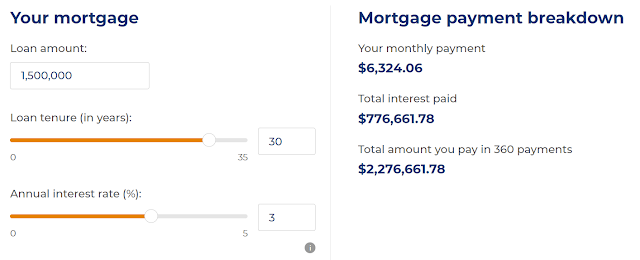
If interest rate continues to increase to say 3.0%, it will mean a monthly servicing of S$6.3K per month. Total interest rate paid over 30 years will be S$777K- I think it is time to buy more shares of DBS, UOB and OCBC listed on SGX which seems to be a better investment. 
3.0% borrowing rate simulation

Well, such pricing is not for the faint hearted folks. Down payment and stamp duties will mean half a million upfront in cash and CPF and not to mention in the current climate of rising bank borrowing rates, it certainly takes great courage to sign the option to purchase. According to property agents, the success of AMO Residence shows that "the market is hungry for attractively priced homes in good locations". Property prices is still a good hedge against inflation according to many people. I am not sure on that. However, I do hope that job losses are kept to a minimum in the upcoming economic downturn and everyone gets to keep their bread and butter. Else it will be extremely painful to support a S$6K per month mortgage. 

Monday, 12 April 2021

Property Investments Seminars Advertisements On YouTube Driving Me Nuts


Not exactly sure what is Marko (and/or something) property investment programme but I was quite disturbed to see frequent Youtube advertisment of it popping out telling me the story from this crying woman. Basically, a woman broke down into tears saying that thanks to Marko (and/or something), she finally managed to move out of her public HDB flat and got to stay in a private condominium as well as to escape the "rat race". Is living in a HDB flat so horrible for her that she broke down into tears just recapping it? Or was it tears of joy from earning lots of money from this property investment programme and now finally flushed with money to buy a private condominium? 

From the advertisement, there is another 22 years old man that says thanks to this programme, he managed to own 2 properties "at such a young age". I think it is better to be modest than to boost about owning multiple properties. I seriously do not think this young man can own 2 properties at such a young age (unless he is really born with a silver spoon in one's mouth). Simple common sense indicates that he must have borrowed tons of money from a bank to finance his properties. Whether the 22 years old man owns 2 properties or the bank is the de facto owners the properties is only a figure of speech. If the marco-economic conditions meltdown totally and banker came to seize his property for a forced auction at the worst possible time, this young man will be in financial ruin and working as a rat (as aforesaid mentioned by the crying woman) in the rat race for the rest of his life paying off millions in bank loans.

Who dare wins?
I reckon that this Marko (and/or something) investment programme is something similar to the well known iQuadrant teaching people to use leverage to purchase multiple industrial properties. The eventual realised return can go up to 30%-40% per annum if everything goes smoothly in finding undervalued industrial properties for rental out and letting tenants help you pay for the properties while awaiting capital appreciation. Well, high risk high return. Obviously, there are people who have made tons of money from employing such strategies taught by the gurus from these properties investment programmes

Parting Thoughts:
Who dare wins is what I believed in. However, I do disagree with the downplaying of leverage to such an extensive extent on industrial properties to portray them as manageable low risk. 

Sunday, 31 January 2021

Personal Updates: Singaporean Venture Into Cambodia Property Investment Horror Story

 
I guess the horror story began back in 2014 when my wife came back home one evening and told me that she had purchased a USD220K 2 bedroom condominium unit jointly with her sister in Cambodia at a road show. The property agent (let's call her Ms M) was a close friend of both of them and has extolled the virtues of overseas property investment because the quantum involved is so much cheaper than getting an investment property in Singapore. Ms M is a successful property investor who currently owns 3 condominium units in Singapore and has accumulated a high net worth from buying and selling Singapore properties. She has also invested in this particular Cambodian project being jointly developed by Singapore based Oxley Holdings and their Cambodian partner.

My initial reactions
I was rather shocked as my wife did not consult or discuss with me on this big ticket item purchase. Her argument then was that she was using her own money. Basically, it works like that, the money she earned is her money but the money I earned is also her money and need to consult her on major item purchase together (unfortunately this is a 1 way street and how it works in my family.....haha).

In addition, Ms M had mentioned 5 "convincing" reasons to wifey for recommending the purchase:
1. Cambodia is an upcoming country in development;
2. The quantum involved to get a condonimum in Cambodia is lesser than a 5 room HDB flat;
3. Oxley Holdings is a well known developer listed in Singapore;
4. The are 3 years of guaranteed rental at 6% per annum by Oxley Holdings & partner;
5. Ms M herself had already purchased 1 unit of the new project in development.

1. Beginning of horror story- USD bank borrowings is around 8% at that time.
The financing rate quoted by the  Cambodian banks for bank borrowings is incredible. No one sane will dare to borrow from them. This seems to have caught my wifey and sister in law by surprise. When they called up to ask Ms M, she brushed this away as saying that she thought the purchase amount is not a large sum and she has all the way plan to finance it by paying in cash for the instalments and assume they will also do that hence it did not cross her mind.

No choice, wifey and sister in law coughed up the USD220K over in hard cash over the course of the work in progress till completion of the project.  

2. Property agent Ms M does not seemed to have reminded her clients/friends that there is withholding tax in Cambodia. 
The selling point seems to have been overemphasis on the 6% guarantee rental by the developer for 3 years. Netting of withholding tax on rental, the amount repatriated is a lot lesser. Also, future capital gains (if lucky and not a loss) made by non-residents is subjected to withholding tax of around 20%. 

3. USD rental return subject to much unfavorable forex conversion costs 
To opt for cash received in SGD back in Singapore leads to additional losses in forex markup. The local bank exchange rate is also another interesting weird point. I told my wife and sister in law to open up USD bank account and then use SingX (started by an ex-Citibank banker) for the conversion to reduce the forex conversion loss due to inferior rates.

4. Guaranteed rental scheme ending soon- Oxley Holdings will not renew it due to poor market conditions.
The rental guarantee scheme will come to an end as informed by developer upon its expiry as COVID has wiped out tourism and many expats and the Cambodia economy is in a virtual standstill. An alternative profit sharing scheme maybe rolled out pending indication of sufficient interest from other Singaporean owners to help pay for the monthly maintenance expenses. 

Also, who will help go to the Cambodian government agency to pay for property tax or other administrative matters? 

I guess the matter of exit plan and contingencies were not addressed during the purchase. "Buy first then see how later" will normally lead to eventual headaches.  

5. Lack of networking to find trustworthy property agents in Cambodian market
In the event that the developer "washed their hands off" the renewal of the rental management scheme, investors will need to either find their own tenants or sell off the property on behalf. The problem is the property agent market in Cambodia is not well established yet and there seems to be a lack of regulation. So how does one find a trustworthy agent? 

Language is also a major barrier for effective communication with the Cambodians agents.

As for selling off the property, I was told that even if one lowers the price significantly, there is currently not a lot of expat buyers due to the COVID situation in Cambodia.

Parting Thoughts
I think that property investment in a developing country is a real headache and will not recommend it...simply too much hassle and risk. For those who also have investment properties in Cambodia, maybe can help share your thoughts on the current predicament and possible solutions or networking referral of a good property agency in Cambodia. 

Sunday, 20 December 2020

A Game Of Thrones in Condominium Disputes And Filing of Case With The Singapore Strata Title Board

This is a follow-up posting from the last one on "Problems With Living In Singapore Condominiums- Not As Glamorous As One Think It Is". When communication breaks down between residents and the Management Committee of the MCST, all hell breaks loose, in particularly, with many egos being at stake, some estate issues will definitely escalate out of control. This is where a group of very pissed off resident group will get together to campaign to overthrow the incumbent Management Council team by mudslinging on social media and tit for tat went on between the 2 parties This is also whereby some residents will file a case with the Strata Title Board ("STB") to take on their own MCST.

1. Procedure of Filing to STB and whereby all residents gets punished from depletion of management funds in the legal dispute.
From my last posting, one typical problem will be whether 2nd and 3rd car can park for free issue in most condominiums  or whether the MCST can enforce stringent wheel clamping rules against fellow residents.

The proceedings at Strata Titles Boards consist of 4 main stages:

(1.1)  Application: The Applicant will file an application against the Respondent.

(1.2) Mediation: All parties (Applicant and Respondent) are required to attend mediation session(s) fixed by the Board. The matter may stop at mediation if parties resolve the dispute at that stage.

(1.3) Hearing: If the matter cannot be resolved at the mediation stage, the Board will give directions to the parties to prepare for a hearing and fix the hearing date.

(1.4) Post-hearing: The Board’s orders is binding on parties and may be enforced at the Singapore State Courts.

1.1 Cost of Application Stage- Money commences burning
An application fee of S$500 is required to submit the application along with the "prayers" being sought. Prayers here is not referring to the religious prayers but rather a specific request for judgment, relief and/or damages at the conclusion of a complaint or petition. The applicant/applicants will typically hire a lawyer at this stage to help prepare the filing and incur additional cost of between S$3K to S$5K.

At this point, the MCST is known as the respondent. The Management Council Members may also be named by the applicant/applicants individually as additional respondents along with the MCST. To get ready a respond, the MCST will typically incurr legal fees for crafting the respond. This can cost anywhere from S$3K to S$5K depending on the number of issues, its complexity and hours spent by the legal counsel.

 1.2  Mediation- Extra money burnt for legal counsel to attend Mediation session on behalf of Applicants/Respondent
The lawyers representing the applicants and the MCST at this stage will be very happy as they can bill around S$3K to attend the mediation session. 

So applicant wasted S$3K out of their own pocket if they hired legal counsel at this stage and the respondent will also waste S$3K. 

Normally, there will be at least 2 mediation sessions before all stakeholders either resolve the issues or decided that mediation is useless and to move on to full hearing. If there is another mediation session, another S$3K will be wasted at each side.

Therefore, at least S$6K will thus be burnt by applicants and respondent respectively at the mediation sessions.

1.3 to 1.4 Hearing and Post Hearing
There will be an STB hearing cost here as well as individual legal counsel cost. This stage typically cost around S$10K to S$20k for each respective party depending on the number of hours spent by the legal counsel on hearing preparation and submission.

One import thing to note here is that many people have the wrong notion that if they win the STB case, they can get back all legal consultation and mediation costs from the losing party. This is totally wrong concept. Only party to party cost and panel hearing cost can be recovered. To give an example, I have known of MCST who spent S$50K in legal fees overall to defend against the prayers sought by the applicants and won the case but in the end only got back S$10K in cost recovery. 

Summary
A typical STB case may thus cost up to S$20K to S$30K for applicants and respondent respectively depending on the number of prayers and the complexity of the issues. This is a lose lose situation as this means that S$40K to S$60K would have been wasted by both parties. The only winners out of this will be the legal counsels. Unfortunately, such incidents are not isolated. There are many people with different personalities and principles living in any estate. Residents should thus participate actively in the Annual General Meeting and ensure that they elect their council members wisely. 

Most importantly, more residents should step forward to take up the thankless job of being a management council member lest the council is left in the control of an extremist group of residents who can then make numerous house rules to turn the entire estate into an army camp or prison which will have negative repercussions such as the estate getting into multiple lawsuits with vendors at Small Claims Tribunal/State Courts or cases lodged by fellow residents at STB.

Monday, 9 November 2020

Problems with Living in Singapore Condominiums- Not as glamorous as one think it is

After buying a brand new condominium and waiting for the construction to reach Temporary Occupation Permit stage typically requires 3-4 years for an average 600 unit size development. Of course, many residents could not contain their excitement upon receiving their keys and moving in after renovating their dream home. But this is where the nightmare will start. 

1. Dealing with hardcore smoker neighbours staying above or below your unit smoking every 2 hours at Balcony

Many condo residents were sold by their property agent the idea of Alfresco dinning by utilising the balcony space. Hence they have planned for dinning tables to be shifted to the balcony area in order to free up inner space and a bigger allowance for the living room.  Alfresco is a style of dining that is casual and often offer a party-like ambience and looks cool. 

However, some condo residents are in for a rude shock when they discover that at dinner time, they often have to breathe in cancer causing harmful second hand smoke coming from their neighbours staying directly at the unit above them or under them. The effect of the second hand smoke is so bad that any units within a radius of 2 floors (approximately 6m) from that chain smoker unit will have second hand smoke drifting into their balcony.

Hence it is a fallacy to believe that upgrading from HDB to a EC or private condominium will mean the end of the 2nd hand smoke issue. This second hand smoke issue will never go away unless one purchases a landed property. 

2. Lack of good talents who wants to volunteer to join the Management Committee after the end of the 1st year
During the 1st year, the developer will run the condo along with the appointed Management Agent. However, by the end of the 1st AGM, the MCST is supposed to elect its own Management Committee ("MC") members. Most of the good residents will not want to volunteer. In Army National Service terms, these are extra duties which snaps up valuable time especially for residents who are still working.  There is also no remuneration for being in the MC to look after the estate. One will also have to deal with countless unreasonable complaints and fellow residents demanding to be served by the MC in all their requests. Hence most residents do not want to take up such thankless job. 

Those who joined will have a few types, namely, (i) truly altruism folks (this group is a rare breed), (ii) power crazy folks, (iii) resident associated with the People's Association or government grassroot and (iv) residents who need to get their children into the primary school of their choice- type (iv) is actually a subset of (iii) as the objective is to form the "Neighbourhood Committee" to promote grassroot outreach into the condo.

3. Carparking Woes
This is the most frequent issue in all condominiums. If there are insufficient carpark lots, this will create a problem. If there are ample carpark lots, this will also still be a problem and headache. The insufficient carpark lot scenario think everyone understands why it is a problem. SO let me elaborate on why a condo with ample carpark lots will also be a big problem. 

In most condominium, carparking house rule will stipulate that every owner will be entitled to 1 carpark lot. Then there will be units without cars and units with multiple car ownership. Those with multiple cars will assert that since there are ample lots, they can park unlimited cars in the condo to save on thousand of dollars of annual season parking. The other non-car owner group will be unhappy and demanded that this is unfair as maintenance such as carparking surface epoxy paintings and carpark barriers maintenance is unfairly borne by them hence they will demand second car parking charges. Once the root of all evil (money) surfaced, then World War 3 will begin in the Condo estate. Hence if during the 1st AGM, the carparking and registration rule is not converted into by-law, some of the owners with multiple cars will start to "play around with the Ënglish" in order to argue the best case scenario for themselves.

There are other issues for carparking rules that I will probably go into more details in my future posts.

Parting thoughts:
A smart and wise resident should propose a motion to convert all the existing house-rules into by-law in order for the MC to have legal powers to enforce them. This is the critical step at the 1st AGM which a lot of newbies do not know. House rules set by developers are just rules that looks fun but in the eyes of the Building Maintenance and Strata Act ("BMSMA"), they cannot be enforced without being blessed by the General Body of residents to convert into by-law.

Saturday, 8 August 2020

Woodleigh Residences Offering Up Till S$250K Worth Of Discount- Property Prices Finally Going Down?

I received a promotional email yesterday (5th August 2020) on upcoming weekend sales discount of up till S$250K for a unit at Woodleigh Residences.  Is property price finally softening? This COVID-19 recession sure is different from the 2008 Global financial Crisis for properties. I recalled that properties price crash by 30% to 40% then. But the Singapore property market appears resilient during this COVID-19 period with only slight decline in prices so far. This is incredible. No wonder Germaine Chow of iQuadrant keeps saying in her advertisements that property prices do not fluctuate as wildly as the stock market (Anyway, I am having an overdoes of Germaine Chow-she keeps popping up on my YouTube videos-would appreciate if anyone can provide technical tips on how can I disable her advertisements). 

S$250K VVIP discount is a lot. Anyone thinking of getting a unit at Woodleight Residences? Or more discounts coming? Well, this appears to be good news for consumers but bad news for SPH shareholders. 

Sunday, 27 October 2019

Sengkang Grand Residences Mixed Integrated Development at Buangkok MRT

Sengkang Grand Residences is one of the most anticipated new launch of the year. This development  is directly linked up with Buangkok MRT station and it has a hawker centre and retail mall inbuilt into it. Residents living in Sengkang Grand will enjoy convenient access to all these amenities right under their home. 

As this is a CDL and Capitaland joint development, one can be assured of the quality of luxury finishing of their purchased home. 

Prices are expected to start from S$1,600psf plus and estimated pricing as follow:
(i) 1 bedder + study: S$798K;
(ii) 2 bedder: S$998K;
(iii) 3 bedder: s$1,498K and
(iv) 4 bedder + flexi: S$2.1Mil

There are a few points here that prospective buyers need to be aware of:

1. Car parking might be an issue- Only 80% of parking lots provided for residents
Total residential units in this development is 680. However, parking lots available are only 544 on level 3, Mezzanine A and B. In other words, only 80% parking lots are provided. The property agents will tell you that many units to be purchased are for investors who will rent out to tenants. Hence these tenants of smaller units will not be driving and only taking MRT. 

I just think that this is very strange for a luxury development as if one can afford paying almost S$1Mil plus for a 2 bedder and above, the residents here will most likely also own a car. As a matter of fact, some may even own multiple cars.  Also, how about visitors of residents to the development?
This may lead to future animosity among residents in the 2nd year AGM after the MCST is formed. Have seen a few cases of such disagreements being surfaced even for 1 to 1 parking with regard to how parking lots are allocated.

Do bear in mind that property agents will not be living in this development after your TOP. So best to get some clarity on how the developer and their first year management plan to resolve this issue.

2. Lack of privacy- Some blocks have up to 10 units per floor.
As the number of floors is only around  8 to 10 levels, the developers have squeezed many units into the 9 blocks in order to get to the 682 units.  Some blocks will have up to 10 units on the same floor while most of the others will have 8 units. The ideal case for private exclusivity is 4 per floor. 

Potential buyers will have to assess whether they are fine living with so many neighbours living together on the same floor. It maybe best to avoid the block with 10 units per floor during selection. 

Potential buyers of Sengkang Grand residences will also need to see whether they are comfortable with the number of lifts serving all units in one block. This is especially so during the morning rush hours when parents are sending kids to school or going to work.

3. Unit Layout- 2 bedders and 4 bedders here are better than 3 bedders in terms of functional usage.
This point can be personal and depends on whether you are a balcony lover. For me, I do not like balcony in the Master bedroom as it is a waste of space. I would rather have this balcony space moved to the living room area to be combined into 1 bigger balcony space than having a space that is neither big nor small for usage. To me, balcony in a master bedroom is just a white space.


Hence I think that the 3 bedder layout is a no no to me. 

4. Facing of some blocks is East and West
In Singapore, I would suggest folks go by the general convention to go for North-South facing units and skip the blocks that have either morning or afternoon sun. If no choice and have to choose a East-West facing block, then go for the stack that only have morning sun (East facing) so that when you come back from work in the evening, your home does not feel too hot and warm which may agitate one especially after a hard and stressful day at work already.

Summary
Overall, Sengkang Grand Residences is a very good development. Since CDL and Capitaland have bid over S$1 billion for the site, their breakeven price is around S$1,500psf. Hence, selling at S$1,600psf plus as a starting base is considered a good price for a new integrated development. For me, at this price, my personal preference would be to buy a cheaper resales unit at Punggol Watertown which has the mega mall Punggol Waterway Point right at the doorstep with Shaw Cinema in it.

Monday, 13 May 2019

Developer SPH and Kajima Slashed Woodleigh Residences Price by 10%-13% from $2000psf to starting from $1733psf For Relaunch in May 2019.

Interestingly, my property agent messaged me last week that Singapore Press Holdings ("SPH") and its partner Kajima had slashed the price of Woodleigh Residences by 10% to 13% from S$2,000psf to as low as S$1,733psf. This was despite their initial assertion that the VVIP launch in October 2018 was a resounding success with over 60% of the launched units sold at an average price of 2,000psf. However, for the re-launch of Woodleigh Residences in May 2019, the developer SPH and Kajima must have decided that the risk of the market downturn may not be worth it and started slashing prices drastically in order to move more units. After all, the developer was only able to sell 30 units on the first weekend of its initial launch albeit declaring that 60% were sold by proclaiming that they only launched 50 units.  

For a 958sqft 3 bedder unit, prices would have dropped from S$1.92Mil to S$1.66Mil which translates to substantial savings of +S$256K for potential buyers relative to the first batch of VVIP. This does not seem fair to those first batch of buyers who had supported this integrated mixed commercial and residential project of SPH and Kajima during launch. I hope that SPH and Kajima would have given some goodwill renovation packages to compensate these initial buyers. 

On the property market front, I am not sure whether other developers will also take the lead in slashing prices but I hope so for the benefit of consumers. Once the music stops, property developers holding on to the most unsold inventories would need a very strong balance sheet to wait out the economic downturn. 

From the stock investing perspective, I have previously highlighted the lingering impairment risk of the Bidadari project, that is, Woodleigh Residences, due to the potential property market downturn and uncleared inventories.  I am glad that SPH has decided to slash the price in order to move their inventory of unsold units. Coupled with the bad news from the US/China trade war today, SPH price has dropped to S$2.40 per share and it may be worthwhile to re-look into their newly transformed property business from the previous media giant model. The new UK student accommodation segment acquisition should prove invaluable in the event of an economic downturn due to earnings resiliency.  

Saturday, 9 March 2019

Florence Residences at Hougang Ave 2- Mega Launch at S$1,450psf average?


Went down to The Florence Residences showflat last week to see the latest upcoming development developed by Logan Property in Hougang. This was originally a HUDC site that was being en bloc. I can still remember visiting one of the units during my search for a resales HDB during 2007/2008. The cost price of a unit then was around S$800K. If only I have bought it then, would have become an instant en bloc millionaire last year....whaha.

This is a huge site that is approximately 386,000sqft in size. The developer will be building 1,410 units. The Florence Residences and is near north east line Hougang MRT station and Kovan MRT station. The side gate at Florence Road will lead to Kovan area with a 10min -12mins walk. Many good eateries such as the famous Punggol Nasi Lemak, Yong's Teochew Kueh and Lola's Cafe are found along Upper Serangoon Road and Simon Road. Since this is within 700m to Kovan MRT station, this is actually a walkable distance to MRT and bodes well for rental or future capital appreciation.

There are over 12 amazing club concepts and 128 facilities in this development. The centerpiece is the gigantic 80m main pool at the center of the estate. The only issue I have is the presence of only 1 swimming pool which is being shared by 1,410 units. For similar en bloc HUDC such as Riverfront Residences and Jadescape, there are 2 swimming pools to spread out residents.  For the internal layout of units, I love the efficient squarish layout of units on display.


However, I nearly fainted when the property agent told me that the developer target to launch this at an average of S$1,450psf. So, a 2 bedder (635sqft) starts from around S$863K, 3 bedder (893sqft) at around SS1.222Mil, 4 bedders (1,281sqft) at approximately $1.675Mil and 5 Bedder (1,668sqft) at S$2.41Mil. I am still shocked at the launch price of units in suburbia areas these days. With S$1,450 psf, one may consider getting a unit at Kovan Residence (right on top of Kovan MRT station) if one does not mind a resales unit. If compare to the upcoming CDL and Capitaland Sengkang Centre Residences at Buangkok which is projected to launch at S$1,650psf to S$1,700psf, Florence Residences thus appeared to be cheaper. Will you buy a unit at The Florence Residences? 

Why Relying on Bank's Fire Insurance for Mortgaged Home Is Technically a Financial Death Sentence? (Part 2)

  Hi Folks, welcome back to Investment Income For Life and my Part 2 yapping on the above subjec t . Coming off from my Part 1 post on Home ...